domingo, 10 de abril de 2016

Unit 8: The Iberian Christian kingdoms (La Reconquista)

In this unit we will study the "Reconquista" from the point of view of the Iberian Christian kingdoms. It was a very long (around 800 years) and complex historical process, that will be decisive for the History of the current Spain and Portugal.  
We will work this unit with the help of these teo presentations:

1) Presentation # 1: Good synthesis, with many maps (an extremely weak point in our book) and some interesting videos. This is the one for our class. 

2) Presentation #2: More extense than the previous one but very well structured anyway. Too long for our class, my recommendation is to watch it at home, because it complete and amplifies some aspects from the previous one.  

Here you have some pictures, helpful for this unit. They are mainly maps, because in our book in this unit the historical cartography is scarse and not very clear.    


Statue to Don Pelayo in Covadonga (Asturias), a memorial for the battle (718-722?) that started the Reconquista


Battle of Alarcos (Ciudad Real) - June 19th 1195 - Castilla (Alfonso VIII) vs. Almohad Empire (Yusuf II), a great triumph for the Muslims 


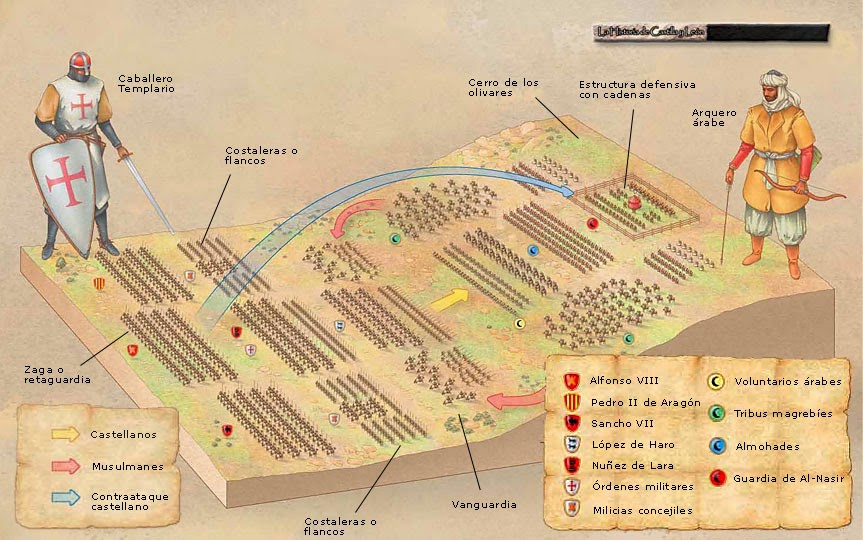
Battle of the Navas de Tolosa (Jaén) - June 16th 1212 - A Christian International League defeated badly the troops of the Almohad Empire


Surrender of the keys of Granada by the emir Boabdil to the Catholic Monarchs, January 2nd of 1492. Last chapter in the Reconquista.  

domingo, 13 de marzo de 2016

lunes, 22 de febrero de 2016

Unit 7: Cities in Medieval Europe

In this unit we shall speak about the Later Middle Ages or, in other words, the 2nd half of the Middle Ages, after the year 1,000 to the end of the period with the fall of Constantinople in Turkish hands in 1,453. 

In order to prepare this unit we shall have a couple of different presentations:


1) Presentation #1: It is fantastic, full of data and very clear. The problem is that is maybe too long, and thus it will be impossible to see it entirely in class. My recommendation, the same as in the previous unit, is to have a general overview (NOT to study it carefully) at home while you have the book in front of you. It includes a lot of contents of Gothic art, many more than in the book and too much for the necessary level in this year. 

2) Presentation #2: It is the one that we shall see in the class. Much shorter and managing, it has some short videos, quite educational and curious.  


martes, 16 de febrero de 2016

Vocabulary for Feudalism (Unit 6)


Vocabulary for feudalism

Cattle/livestock – ganado
Poultry – aves domésticas
Hens- gallinas
Oxen-buey
Bees-abejas

Crops- Cultivos/cosechas
Vine- vid
Harvest-cosecha
Cereals- cereal
Wheat-trigo
Rye-centeno
Barley-cebada
Oats-avenas

Acorns- bellotas

Pulses-legumbres
Lentils-lentejas
Chickpeas-garbanzos
Beans-judía, alubia, frijol


Garlic- ajo
Ham- jamón

Plough-arado
Scythe-guadaña
Sickle-hoz, segadera

Windmill-molino de viento
Watermill- molino de agua

martes, 2 de febrero de 2016

Unit 6: The feudal Europe

Here you are a couple of presentations as a help to prepare this new unit about the Middle Ages in the Christian Europe:

1) Presentation #1: It is very extense and complete. It is good for to ampliate and consolidate your general ideas about this period, but maybe you can found it too long in terms of study. My recommendation is to wacht it quietly at home while you are reading this unit in our book. 


2) Presentation #2: Is the one to be used in the class. Shorter and more managing, it has some graphs and pictures very useful and clear. The bad part is that sometimes it has too much writing, that at the end it actually repeats the same contents than in our book.  


martes, 19 de enero de 2016

Videos about Al-Andalus

Here you will see a couple of relevant videos about the History of Al-Andalus.

The first video is about the diachronic sequence of the Muslim Iberia and its different historical phases since the arrival of the Emiral armies in 711 to the fall of Granada in 1,492.


The second video is focused to the sequence in the building of the great Mosque Alhama in Córdoba: